Charge-neutral triesters for next-generation oligonucleotides
This note introduces phosphothiotriester (PTTE) and phosphate-triester (PTE) backbone chemistry as a synthetically accessible, modular alternative to the conventional phosphorothioate (PS) backbone used in most approved oligonucleotide therapeutics, which suffers from toxicity and reduced RNA affinity. By combining these triester linkages with LNA sugars and lipid conjugates such as 5′-palmitate, the work shows that backbone charge, RNA-binding affinity, nuclease stability, and cellular uptake can be tuned together rather than relying on a single modification. This matters because it addresses key limitations of current RNA drugs (limited cellular uptake, nuclease degradation, and off-target protein interactions) while remaining compatible with established synthesis and major sugar chemistries. The result is a rational, multi-parameter design framework for building safer, more potent next-generation RNA therapeutics across ASOs, siRNA, splice-switching oligonucleotides, and CRISPR RNA.
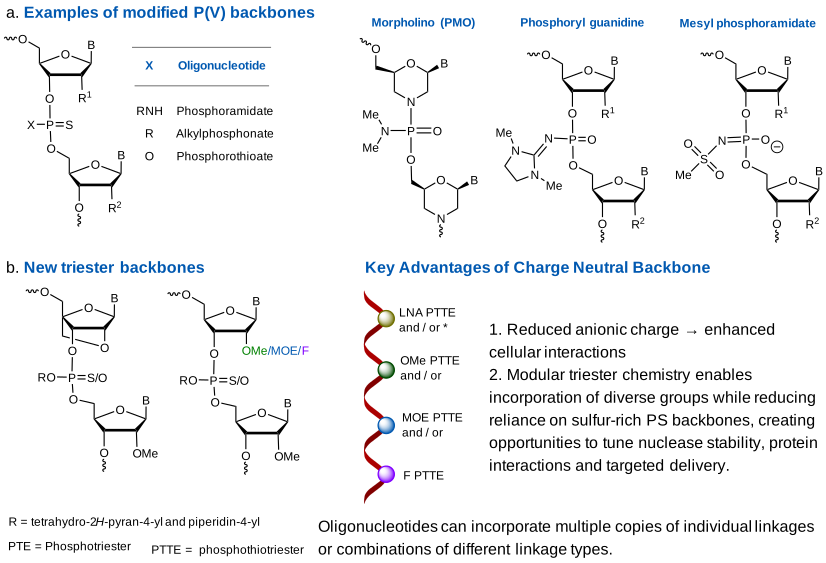
Fig.1, a. General structural motifs of different modified P(V) oligonucleotide backbones, b. Generic chemical structures of triester-oligonucleotides, highlighting their key features.
Therapeutic oligonucleotides have emerged as a transformative class of medicines capable of directly targeting disease-associated RNA, opening new therapeutic opportunities for genetic disorders that were previously difficult to address [Crooke et al., 2021]. However, their broader therapeutic potential remains constrained by challenges including limited cellular uptake and tissue distribution, the need for nuclease stability, and the relatively narrow range of backbone chemistries represented in approved oligonucleotide medicines. Most clinically used oligonucleotides rely heavily on phosphorothioate (PS) backbones which provide improved nuclease stability and favourable pharmacokinetic properties [Eckstein, 2014] but reduce RNA-binding affinity and promote non-specific protein interactions, leading to toxicity. Developing alternative backbone modifications that can overcome these limitations while remaining compatible with established oligonucleotide synthesis is therefore an important goal in RNA therapeutics.
Recently, a strategy was developed to introduce charge-neutral phosphothiotriester (PTTE) and phosphate-triester (PTE) linkages into the modified oligonucleotide backbone. It was demonstrated that oligonucleotides bearing multiple LNA-PTTE or LNA-PTE linkages could be prepared using conventional phosphoramidite-based solid-phase synthesis [Dhara & Brown, 2026]. The resulting oligonucleotides exhibited excellent RNA-binding properties, high duplex stability with complementary DNA, and strong resistance to nuclease degradation. Importantly, LNA-triester chemistry also provided a modular platform for further functionalisation, including the incorporation of alkynyl groups that enable conjugation to lipids, carbohydrates, polyamines and other molecular structures through click chemistry [Crooke et al., 2021]. These findings established this new plartform as a synthetically accessible and versatile alternative to conventional PS backbones, while also demonstrating that backbone and sugar modifications can be engineered cooperatively to tune oligonucleotide properties. In particular, replacing PS linkages with PTTE or PTE reduces the overall negative charge, and the latter lowers the sulfur content of the oligonucleotide with implications for improved delivery into cells. The combination therefore provided a means of simultaneously tuning backbone properties and RNA affinity in therapeutic oligonucleotides.
Building on this foundation, piperidyl phosphothiotriester (PTTE) linkages were developed, introducing a protonatable amine into the backbone [Dhara et al., 2024]. This modification moves beyond simple charge neutralisation and provides a more potent means of modulating the electrostatic properties of the oligonucleotide. When piperidyl PTTE linkages were combined with LNA, the resulting oligonucleotides exhibited enhanced RNA affinity compared with the charge-neutral versions. These results demonstrated that protonatable functionality within their backbone can be used to modulate oligonucleotide–RNA interactions and further highlight the potential of triester chemistry as a platform for systematic backbone engineering.
An important question in the triester studies was whether enhanced RNA affinity translates directly into improved biological activity. Increasing RNA affinity (e.g. via LNA-PTTE) does improve potency but only up to a point. Oligonucleotides with very high affinity for RNA actually have lower activity, possibly due to a loss of their catalytic effect. This was most striking for conventional LNA oligonucleotides. Fortunately, incorporation levels of LNA triesters can be fine-tuned to achieve optimal oligonucleotide activity.
An interesting synergistic effect was discovered by combining 5′-palmitate lipid and internal piperidyl triesters in oligonucleotides. Substantially enhanced splice-switching activity was achieved under gymnotic conditions. This finding highlights the multidimensional nature of the problem: although target binding and duplex stability are important, biological performance is also governed by properties such as backbone charge, nuclease stability, cellular uptake, and intracellular trafficking. Thus, increasing RNA affinity alone is insufficient to maximise biological activity; effective oligonucleotide design requires simultaneous optimisation of multiple structural and physicochemical parameters.
Taken together, these studies establish a progression from backbone replacement to integrated molecular design. The initial studies demonstrated that PTTE chemistry provides a synthetically accessible and modular alternative to conventional PS backbones, while the subsequent piperidyl PTTE study showed how backbone charge modulation, LNA-mediated RNA affinity, and lipid conjugation can be combined to influence biological properties. Rather than relying on a single chemical modification to overcome the limitations of oligonucleotide therapeutics, the backbone, sugar, and conjugate can be independently engineered to control different aspects of molecular behaviour. This modular approach provides a framework for the rational design of next-generation RNA therapeutics by balancing target affinity, molecular stability, charge, cellular uptake, and intracellular trafficking to achieve the desired biological response.
Finally, the new triester chemistry is also compatible with 2'-OMe 2'-MOE and 2’-fluoro sugars, making it an exciting prospect for inclusion in exon-skipping oligonucleotides (SSOs), antisense oligonucleotides (ASOs), small interfering and micro RNAs (siRNA and miRNA), as well as CRISPR RNA [Dhara & Brown, 2026].
Ayan Dasgupta and Tom Brown, September 2026
References
- 1.
Crooke, S. T.; Baker, B. F.; Crooke, R. M.; Liang, X. h. (2021). Antisense technology: an overview and prospectus. Nature Reviews Drug Discovery.
https://doi.org/10.1038/s41573-021-00162-z - 2.
Eckstein, F. (2014). Phosphorothioates, Essential Components of Therapeutic Oligonucleotides. Nucleic Acid Therapeutics.
https://doi.org/10.1089/nat.2014.0506 - 3.
Dhara, D.; Brown, T. (2026). 5′-Palmitate Lipid and Internal LNA-Piperidyl Triesters Enhance the RNA Affinity and Activity of Splice-Switching Oligonucleotides. Journal of the American Chemical Society.
https://doi.org/10.1021/jacs.6c07448 - 4.
Dhara, D.; Hill, A. C.; Ramesh, A.; Wood, M. J. A.; El-Sagheer, A. H.; Brown, T. (2024). Synthesis, Biophysical and Biological Evaluation of Splice-Switching Oligonucleotides with Multiple LNA-Phosphothiotriester Backbones. Journal of the American Chemical Society.
https://doi.org/10.1021/jacs.4c11402