Probes for real-time PCR and genetic analysis
Every qPCR probe chemistry solves the same problem, telling you a target sequence is present, and each solves it differently. The right choice depends on your assay: how much background you can tolerate, how fast you need signal, and whether you are detecting presence or absence, or discriminating a single base.
TaqMan probes hydrolysis probes
A dual-labelled linear probe with a reporter dye at one end and a quencher at the other, designed to bind the target between the forward and reverse primers. While the quencher sits close to the reporter, fluorescence stays suppressed. During extension, Taq polymerase's 5′→3′ exonuclease activity cleaves the probe as it displaces it from the template, separating reporter from quencher and releasing fluorescence proportional to amplicon copy number. Because signal generation is tied to cleavage, not just binding, hydrolysis probes are the standard for quantitative real-time PCR.
Dual-labelled probes are HPLC purified as standard and supplied at 200 nmol, 1 µmol and 16 µmol scales, with the reporter and quencher of your choice from the list below. Matching unlabelled forward and reverse primers are supplied on request.
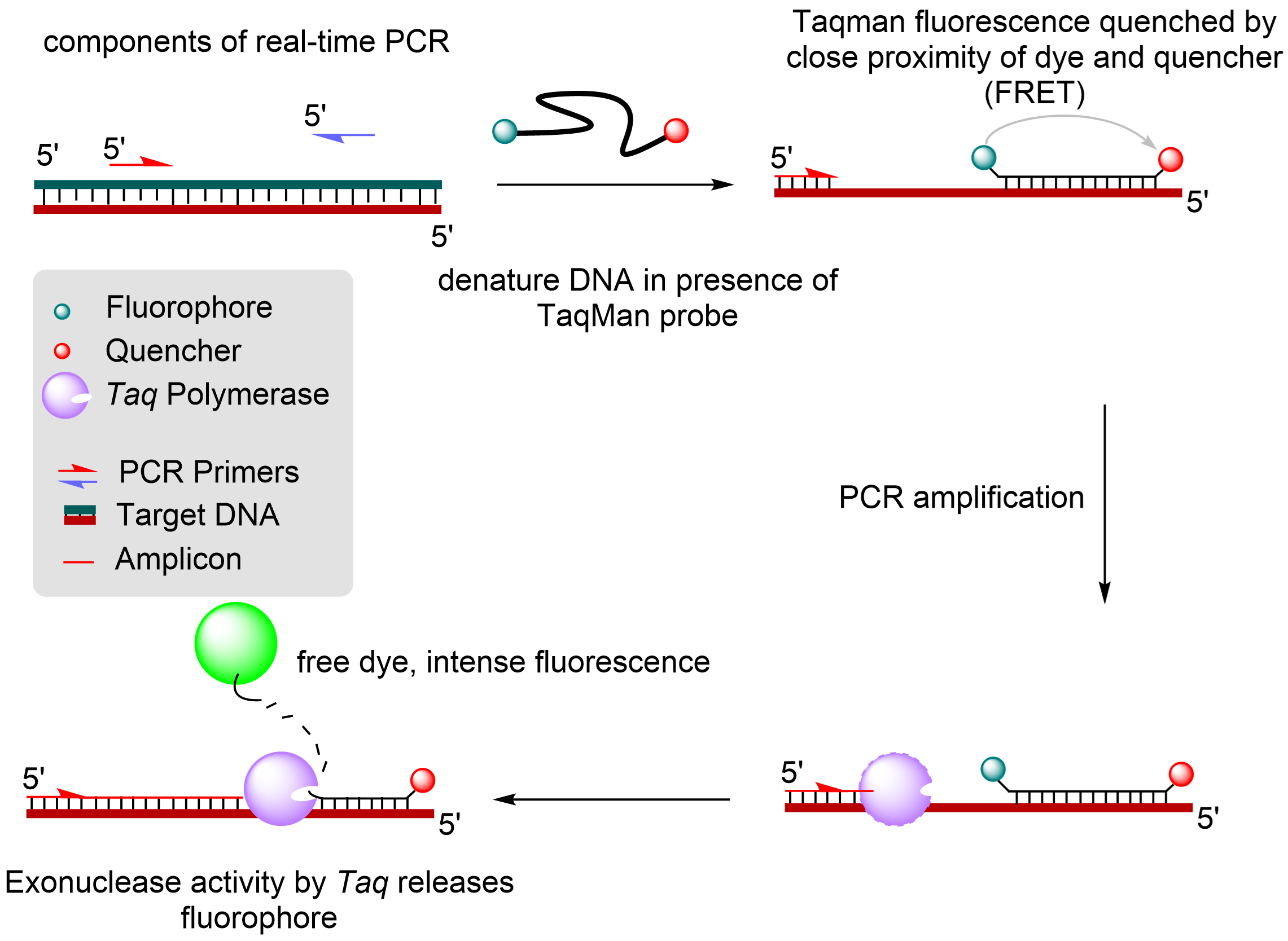
Single-quenched
Reporter at the 5′ end, quencher at the 3′ end only: the simplest, most widely used format.
Double-quenched
Adds a second quencher internally, between bases 9 and 10 from the 5′ end, shortening the dye-to-quencher distance. Markedly lower background than a single terminal quencher, improving Ct and sensitivity, and it holds up even on longer probes (40 nt and longer) for low-complexity targets.
Other probe formats
Molecular beacons, Scorpion primers and HyBeacons, plus directly labelled and FRET-pair probes for FISH, microscopy and other hybridisation-based applications, all made and released to the same labelling and QC standards as our TaqMan probes. Scorpion primers and HyBeacons were co-invented by Tom Brown, Assemblon’s co-founder.
Molecular beacons
A stem-loop hairpin holds fluorophore and quencher together when unbound. Binding the target loop forces the hairpin open, separating the pair. Reversible, and sharp enough to distinguish a single mismatch, well suited to allelic discrimination and SNP genotyping.
Scorpion primers
A primer covalently joined to its own hairpin probe via a HEG blocker. In the first cycle the primer extends and the hairpin stays closed. In the second the probe folds back and binds the new strand within the same molecule. No hydrolysis involved, just faster, unimolecular hybridisation than a probe finding its target from solution. Uniprobe and bi-probe formats available.
HyBeacons
A single internally attached dye, no separate quencher. Solvent-exposed and dim when unbound; fluorescence rises on hybridisation. The single-label design and melt-curve shape make it a natural fit for high-resolution melt analysis and genotyping, including heterozygote calls.
More than a synthesis service
Getting a probe to perform well in your assay is about more than the chemistry on paper. Whether you are weighing up probe formats, choosing where to place a quencher, or trying to understand why a design is not behaving as expected, our team brings hands-on experience in probe design and troubleshooting to every project, not just a synthesis order. Tell us what you are trying to achieve and we will help you think it through. The initial consultation is free. For a first estimate of probe and primer Tm, use the melting temperature calculator.
Analysis built for fluorescent probes
A probe carries a failure mode that standard oligo QC does not always catch: the label itself. Every probe is analysed by UPLC-MS against strict release criteria, but a generic method can miss what a probe-specific one is built to find.
Free dye and unlabelled oligo
Two contaminants matter most: any free, unconjugated dye left in the product, and any oligo that never picked up its label at all. Both are removed during purification, not just flagged afterwards. Unlabelled oligo is easy to overlook: it does not show up on a simple fluorescence check, but it quietly dilutes your signal. Because the unlabelled fraction can vary from batch to batch, leaving it in is also a common, avoidable cause of inconsistent performance run to run.
Dye integrity through synthesis
Some dyes do not survive oligo synthesis and deprotection unchanged. A structurally degraded dye can still look like a normal peak on a simple check while performing differently in your assay. We choose synthesis and deprotection conditions to suit the dye, and our UPLC-MS methods are set up specifically to catch degradation before release, not just confirm a peak is present. Where a dye has not behaved as expected, we work through the best way to make that particular oligo so you get the probe you actually ordered.
Every probe ships with its datasheet and UPLC-MS result; the chromatogram is available on request.
Fluorophores and quenchers
We work with fluorophores and quenchers across the visible and near-infrared spectrum, chosen to match your instrument's channels and your multiplexing plan. The selection below is representative, not exhaustive. If you need something specific that is not shown, ask us.
Trademarks and trade names above are the property of their respective owners and are used only to identify the products concerned.
Talk to us
Send us the sequence and one of our experts will tell you whether it is feasible, what it will cost and how long it will take, before you commit.